
On the early journeys that taught me travel could mean freedom—and distance.

The Beginning—When Travel Meant Safety
By the time I was twelve, travel had already become something familiar—not just a way of seeing the world, but a way of understanding it.
My grandmother gave me my first holidays after my mum died. Every summer we’d fly to the south of Spain to stay with my aunt. It was always the same seaside town, the same rhythm of days, the same salt-thick air. Mornings were for the beach, afternoons for long lunches and naps behind closed shutters. The heat wrapped around everything, the sound of cicadas filling the pauses in conversation.
Those trips weren’t about discovery; they were about safety. After so much loss, repetition was a kind of healing. I knew what to expect—the lemon trees in the courtyard, the walk to the sea, the slow light of evening. For a child who had already seen too many goodbyes, that predictability was its own kind of peace.
That’s what travel meant to me at first: the reassurance of the familiar. It was the world’s way of saying, You’re still safe here.
The Gifts—When Distance Spoke for Love
My grandfather was a different story. He had left my grandmother when I was five, not long after my mum died, and for years he existed only through rumours and postcards. But when my dad passed away when I was ten, he began to reappear—suddenly, unexpectedly, as if trying to make up for lost time.
He didn’t quite know how to be close, so he used travel as a bridge. Or maybe it was guilt. Either way, it became his language. He would return from business trips with gifts from faraway places: a jumper from America two sizes too big, a soft toy from Germany, a pair of shoes from England. Things that smelt of elsewhere.
I think that’s when I began to equate distance with affection. His presents were proof that I was still remembered—that somewhere, even in his absence, I occupied space in someone’s mind. Travel, for me, became tied to reward: the promise that love could be sent by airmail, wrapped in duty-free paper.
It was never said aloud, but I learnt it quietly—that to be loved meant to be thought of from afar.
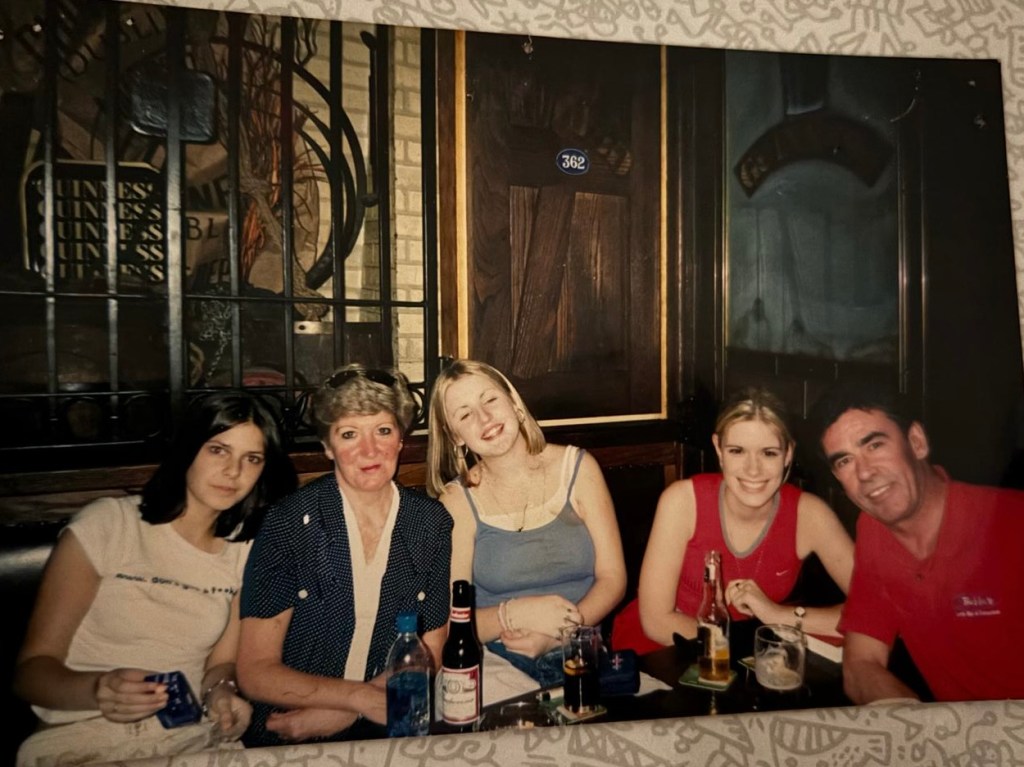
My Irish Family
The Journeys—When Freedom First Took Shape
Eventually, the gifts turned into journeys. When I was ten, my grandfather began sending me abroad each summer to study English—first to Ireland, then to Canada.
In Ireland, I stayed with a family who knew my story. They never tiptoed around it; they simply welcomed me. They treated me like one of their own, folding me into their everyday routines—dinners at the table, walks through the city, easy laughter. They were the ones who taught me English, patiently and without judgment. For that, I’ll always be grateful. Learning the language changed everything: it gave me a voice I didn’t know I needed and, years later, opened the door to the life I built in London—my work, my marriage, my sense of independence.
We kept in touch for many years, exchanging letters, phone calls, and holiday cards, until the mother passed away from cancer. Even now, I think of her with tenderness—she was one of the first people who showed me that kindness doesn’t need grand gestures. Sometimes it’s just space, freely given.
Canada came next—a different host family each year. Each house had its own rhythm, its own smell. The last family I stayed with is still in my life. I remember the father best—a gentle man who loved Star Trek and tried, with endearing persistence, to make me a fan too. We’d sit together in the evenings eating ice cream with crushed Oreos, talking about nothing in particular. I didn’t realise it then, but those small conversations were teaching me something about belonging—that it could exist even in temporary places, even when you were always preparing to leave.

The City—When the World Opened
Every trip to Canada began or ended with a stop in New York, and that’s where I fell in love with big cities.
There was something magnetic about it—the chaos, the rhythm, the anonymity. You could disappear into the crowd and still feel connected to it, part of the hum of millions of lives. I remember standing on a busy corner, watching taxis blur into yellow streaks, feeling both completely invisible and strangely seen.
New York taught me that cities have their own kind of freedom. In their noise and movement, there’s a release—a place where no one asks where you’ve come from or why. It’s a kind of forgiveness, really. I think that’s why I’ve always gravitated towards big, noisy places. They let you exist without explanation.
When I turned fifteen, my grandfather kept a promise he’d made years earlier: he took me to Disneyland in Orlando. It had been a dream from the moment he’d first mentioned it, and when it finally happened, it felt like closing a loop. It wasn’t about the rides or the magic; it was about a promise kept—about someone showing up when it mattered.
That trip was different. It wasn’t a lesson in language or independence. It was about connection—imperfect, complicated, but real.
The Aftermath—When Freedom Grew Heavy
But freedom has its shadows. Every return felt a little heavier, every goodbye a little sharper. The more I travelled, the harder it became to define where home really was.
When you grow up learning to move, stillness starts to feel foreign. I’d unpack my suitcase only to repack it again, waiting for the next trip, the next version of myself. Home stopped being a place and became something I carried inside—a fragile idea rather than a physical space.
By the time I moved to London at twenty-three, it didn’t feel like a bold leap. It was simply the next chapter in a life built on motion. The idea of starting over somewhere new wasn’t frightening; it was familiar. Movement had become my comfort zone.
The Reflection—What Those Early Journeys Taught Me
Looking back now, I can see those summers for what they were—not just holidays or language programmes, but quiet lessons in freedom and distance. They shaped how I see the world and how I navigate it. They also taught me the cost of always being able to leave.
Growing up through movement teaches you adaptability, resilience and courage—but it also teaches you impermanence. You learn to belong everywhere and nowhere all at once. You learn to love people and places while knowing you’ll eventually have to say goodbye.
Those journeys were my first attempts at independence, but they were also the roots of a restlessness that would take years to understand. They taught me that travel can be both liberation and escape—that sometimes, the same road can lead you towards freedom or away from yourself.
💌 If this story resonates, subscribe to read the next chapter—”Leaving Home, Following Roads,” about moving to London at twenty-three and learning what it really means to belong.


 Wanderlust Reconsidered
Leave a comment