
On love, patience, and learning to share the road.

The Beginning—When Paths Crossed
He wasn’t a traveller. Not in the way I was. When we met, he’d never left home before moving to England for work. Travel wasn’t a dream for him; it was a necessity, a means to an end. But sometimes, life pairs opposites—one restless, one rooted—and somehow they find balance.
We met in the hotel where I worked as a reception team leader. He was a luggage porter—quiet, observant, always in motion but never hurried. Our paths crossed between long shifts, small disagreements, and the occasional after-work pint in a tired London pub. There was something steady about him, something that anchored the noise around us.
When his accommodation fell through, and his flatmates began drifting into their own lives, he moved into my tiny room in Camden. It wasn’t planned—just what made sense at the time—but it marked the beginning of us. We learnt to share space, to navigate London together, and to stretch small paycheques into rent, groceries, and the odd treat: a takeaway, a night bus home, a lazy Sunday morning.
We were young, exhausted, and wildly unprepared for the grown-up lives we were building. But somehow, it worked.
The First Journeys—When Home Expanded
Our first trips together were homecomings—to Spain, to meet my family, and to Lithuania, to see his. Two worlds, both full of warmth and chaos, opening to each other through us.
Those early visits taught me something important: travel isn’t only about discovering the unfamiliar; sometimes it’s about seeing your own life reflected in someone else’s. My family welcomed him with the same noisy affection they gave everyone. His, quieter but no less genuine, folded me into their routines with simple gestures—shared meals, slow walks, an extra jumper pressed into my hands when the Baltic chill caught me off guard.
It was during those trips that I began to realise how love, like travel, teaches you to translate—to read silences, gestures, small kindnesses that speak louder than words.

The Leap—When a Dream Took Flight
Then came Japan—the place I’d dreamt of since childhood.
For years, I’d devoured travel books and films, fascinated by the culture I’d glimpsed through anime and stories. Japan felt like another world—precise, beautiful, and far away. When an opportunity came to advance my career as an Assistant Reception Manager, I took it, even though it meant a temporary contract in a hotel that was closing down. Ten months of hard work in exchange for one promise: double pay in the final month. That money became my ticket.
I wanted to go alone, but the truth was, I was afraid. Japan felt too far, too unknown. One evening, nervously, I asked him if he’d come. I half-expected him to say no—it felt too early in our relationship, too much to ask. But he didn’t hesitate. He said yes.
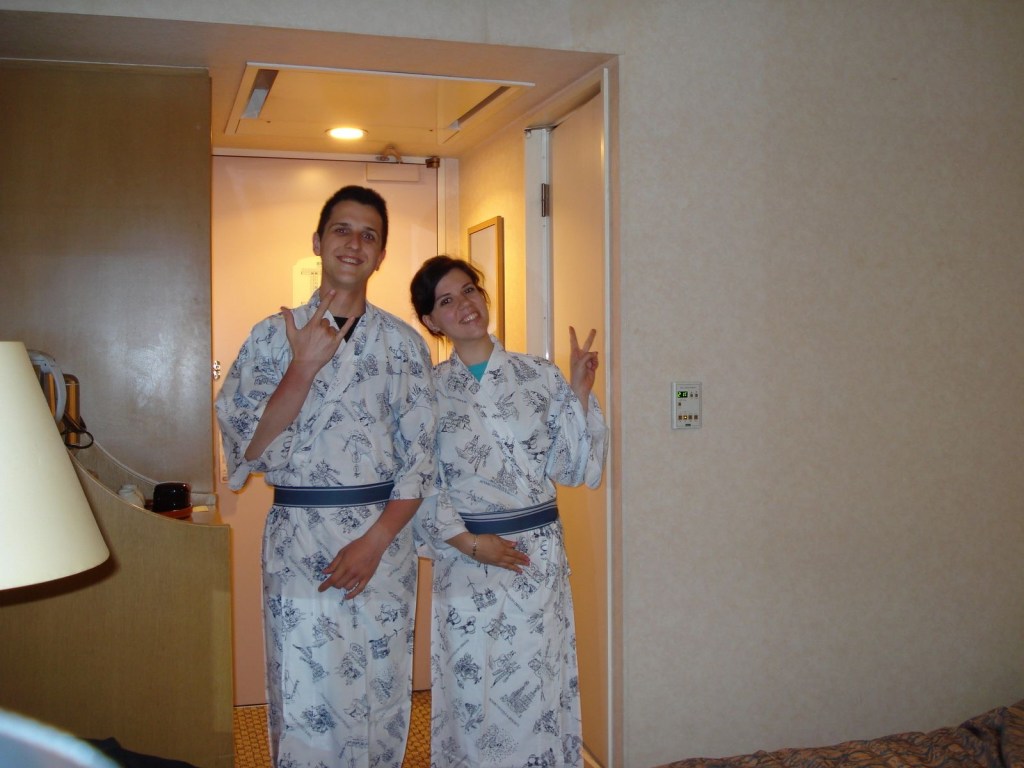
We booked the cheapest flights we could find, stayed in budget hotels, and gave ourselves just £500 each to spend. I was earning £7 an hour, he around £6—travel was a luxury we couldn’t really afford. But even with the ramen dinners and convenience store snacks, it remains one of the best trips we’ve ever taken.
Tokyo was everything I’d hoped for—neon chaos and quiet temples, crowds that somehow moved in harmony. Kyoto was beauty distilled into stillness; Hakone, a mist-wrapped dream. We got lost more times than I can count, laughed until our feet hurt, and learnt that adventure isn’t about luxury—it’s about curiosity and patience.
Back then, Japan was quieter. Fewer tourists, fewer English signs. It felt like a secret world. I think that’s why I loved it so deeply—because it felt earned.
That trip marked something for both of us. For me, it was the fulfilment of a lifelong dream. For him, it was the start of seeing travel not as escape, but as connection—to the world, to each other.
The Companionship—When Love Learnt to Travel
Since Japan, he’s become my companion in every sense. We’ve explored together—sometimes joyfully, sometimes tiredly—but always side by side. He’s patient with my need to wander, indulgent of my endless curiosity. I know travel isn’t his passion, but I also know it’s his way of showing love: to join me in the places that move me, to share what I find meaningful.
He never treated me differently because of my past. I told him the story of my childhood one night, slightly drunk in a black cab on the way home. He listened quietly, without pity or surprise, and then carried on the conversation as if I’d told him something as ordinary as the weather. That, in its own way, was the greatest kindness.
His steady acceptance softened something in me. It allowed me to talk about my past without fear, to eventually travel without feeling like I was running away. It taught me that movement doesn’t have to mean escape—sometimes it’s just a way of sharing a life.
The Reflection—When Movement Found Meaning
Looking back, I can see that for many years, travel was still something I chased. Even after Japan, even after finding love and stability, I kept moving—constantly searching for the next place, the next experience, the next horizon.
It wasn’t about luxury or escape anymore, but about rhythm. I needed movement the way some people need quiet—the reassurance of motion, of airports and departures, of having something to look forward to. I planned the next trip before the last one had even ended. It was as if staying still meant falling behind.
He understood that about me. Patiently, he stood beside me through it all—the endless lists, the late-night searches for cheap flights, the way I could only seem to breathe properly once a new adventure was on the calendar. He joined me, not because he needed to, but because he knew I did. I think that’s his version of love: to travel because I can’t not, to find joy simply in watching me discover.
And though he enjoys it now—the newness, the memories, the small rituals we’ve made of it—he could live without travel. I couldn’t. Not then.
It took a long time and a global standstill for that to change. When COVID arrived and the world went quiet, I was forced to stop. At first it felt like withdrawal—the absence of airports, of motion, of purpose. But in that stillness, travel began to mean something else again.
It stopped being a fix—something to soothe or distract—and became a choice. A slower, more deliberate act of curiosity. I learnt to enjoy it differently: not to go somewhere, but to be somewhere.
Now, when I travel, it’s less about escape and more about connection. The restlessness hasn’t vanished—I don’t think it ever will—but it no longer drives me. Instead, it walks beside me, quieter, content just to see where we end up next.

💌 If this story resonated, subscribe to read the next post— “The Chase,” about the years when I believed travel was the answer, and what I found when I finally stopped running.


 Wanderlust Reconsidered
Leave a comment